You want to tell a simple story: what happened yesterday. Suddenly Spanish asks you to choose between two past tenses. Was the action completed? Was it background? Did it happen repeatedly? Did another event interrupt it? English often uses the same simple past form where Spanish selects either the preterite or the imperfect.
That difference is not merely grammar. It is storytelling perspective. The preterite presents an event as a bounded whole. The imperfect looks inside an ongoing situation, habit, or background state. English-speaking learners may continue refining this contrast at advanced levels, so confusion is expected. A strong mental model makes it manageable.
Think camera, not translation
Imagine a film.
The imperfect sets the scene:
Era de noche. Llovía. La calle estaba vacía.
The preterite advances the event line:
De repente, llegó un coche y una mujer bajó.
Background does not mean unimportant. It means the speaker presents the situation as open or ongoing around the main events.
Use the preterite for bounded events
The preterite commonly presents:
### Completed actions
Ayer compré un libro.
### Events in a sequence
Entré, saludé a todos y me senté.
### Beginnings and endings
La película empezó a las ocho y terminó a las diez.
### Changes or realizations viewed as events
De repente, entendí el problema.
Time expressions such as ayer, anoche, el sábado pasado, and una vez often accompany the preterite because they frame events within a bounded period. They are clues, not automatic switches.
Use the imperfect for an inside view
The imperfect commonly presents:
### Repeated or habitual past actions
Cuando era niño, jugaba al fútbol todos los días.
### Ongoing background
Mientras trabajaba, escuchaba música.
### Descriptions, age, time, weather, and states
La casa era grande. Tenía veinte años. Eran las nueve. Hacía frío.
### Plans or intentions in progress
Iba a llamarte, pero se me olvidó.
The imperfect does not tell you whether the situation later ended. It simply does not place the endpoint inside the frame.
Combine them to tell real stories
The most useful practice is not choosing one tense in isolation. It is combining them:
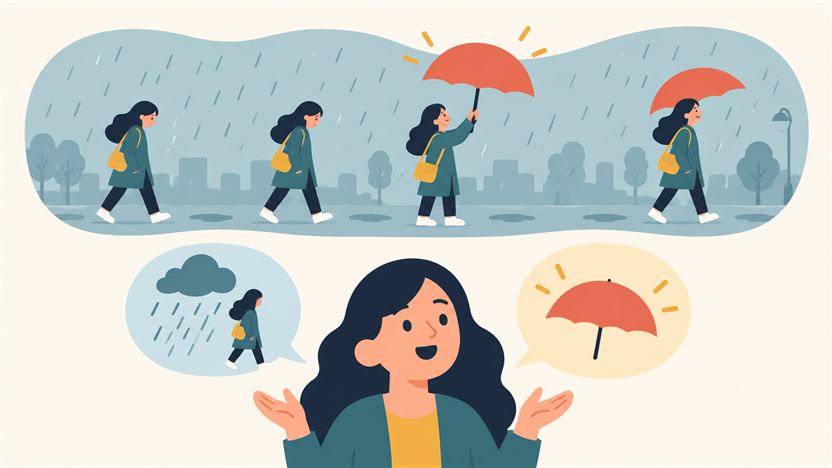
Caminaba por el parque cuando empezó a llover.
The walking is the ongoing frame. The rain begins as a bounded event.
Mientras cenábamos, sonó el teléfono.
Dinner was in progress. The phone rang and entered the event line.
Do not memorize “imperfect plus cuando, preterite after it” as a rigid rule. Context can reverse expectations. The point is how each event is viewed.
Notice how meaning changes
Some verbs create useful contrasts:
- Sabía la respuesta. — I knew the answer.
- Supe la verdad ayer. — I found out the truth yesterday.
- Conocía a Marta. — I knew Marta.
- Conocí a Marta en 2020. — I met Marta in 2020.
- Podía salir. — I was able / had the ability to go out.
- Pude salir. — I managed to go out.
- Quería hablar con él. — I wanted to talk to him.
- Quise hablar con él. — I tried or made the bounded attempt to talk to him, depending on context.
These are not arbitrary vocabulary changes. The tense changes the viewpoint, and the new viewpoint produces a natural English translation.
Avoid the “duration” trap
A long action can use the preterite if it is presented as complete:
Viví en Madrid durante diez años.
A very short action can use the imperfect if it is repeated or viewed as ongoing:
Cada vez que entraba, sonreía.
Length does not decide the tense. Bounded versus unbounded viewpoint does.
Build stories in layers
Use a picture or memory and create three layers.
Layer 1: Scene. Where were you? What was the weather like? Who was present? Use the imperfect.
Layer 2: Events. What happened first, next, and last? Use the preterite for the event line.
Layer 3: Intersections. What was happening when an event occurred? Combine both tenses.
Example:
Era viernes y hacía mucho calor. Yo estaba en casa y trabajaba en la cocina. A las cuatro, alguien llamó a la puerta. Abrí y vi a un amigo que no veía desde hacía años. Entró, hablamos un rato y después fuimos a cenar.
The tenses now serve the narrative rather than appearing as a worksheet puzzle.
Use timelines carefully
Timelines help, but they can oversimplify. Draw imperfect situations as open bands and preterite events as bounded boxes. Then describe the same event from two perspectives.
Estudié toda la tarde treats the study period as a completed whole.
Estudiaba por la tarde presents it as a habit or background.
The real world did not change. The speaker’s framing did.
Study input like a storyteller
Take a short narrative and highlight imperfect verbs in one color and preterite verbs in another. Ask:
- Which sentences establish the scene?
- Which verbs move time forward?
- Where does the writer pause the event line to describe something?
- Which event interrupts or changes the situation?
Then retell the story without looking. Keep the structure even if your wording changes.
Practice with meaningful corrections
If a teacher changes your tense, ask what meaning your original form created. Sometimes both forms are grammatical but tell slightly different stories.
Do not write “wrong tense” and move on. Save the contrasting sentences with a short note:
Vivía allí = background or ongoing residence.
Viví allí tres años = completed period presented as a whole.
Meaning-based corrections are easier to reuse than rule labels.
A one-week past-tense workout
Day 1: Describe a childhood routine with the imperfect.
Day 2: List ten completed events from yesterday using the preterite.
Day 3: Combine background and events in five cuando or mientras sentences.
Day 4: Highlight both tenses in a short story.
Day 5: Retell that story from memory.
Day 6: Record a personal story for two minutes.
Day 7: Review corrections and record it again.
Tell the story first
Do not wait for perfect control before telling stories. The contrast becomes automatic through meaningful narration, not endless hesitation.
When choosing, ask: Am I setting the scene, showing an ongoing or repeated situation, or describing a state? The imperfect is likely. Am I presenting a completed event, transition, beginning, ending, or step in a sequence? The preterite is likely.
These questions will not solve every advanced nuance. They will give you a strong, usable foundation—and they will let you tell the stories that make conversation worth having.