Why is a table feminine, a book masculine, and a hand—despite ending in -o—also feminine? For native English speakers, Spanish gender can feel like an extra label attached to every noun for no practical reason.
But gender is not only a noun label. It creates a network of agreement: articles, adjectives, demonstratives, and sometimes pronouns change to match. Research with English-speaking learners shows that even advanced students can continue struggling with gender assignment and agreement. That persistence is exactly why “just remember -o and -a” is not enough.
You need a system that treats gender as part of the word from the beginning.
Learn the article with the noun
Do not learn mesa as “table.” Learn la mesa. Do not learn problema alone. Learn el problema.
The article is a compact memory signal. It also makes review more natural because Spanish nouns normally appear inside phrases, not as floating dictionary entries.
When making vocabulary cards, put the full unit on the answer side:
- a map → el mapa
- a song → una canción
- this hand → esta mano
- the system → el sistema
Say the phrase aloud. Sound and rhythm help bind the pieces together.
Use endings as clues, not laws
Many nouns follow familiar patterns:
- Nouns ending in -o are often masculine: el libro, el vaso.
- Nouns ending in -a are often feminine: la casa, la ventana.
- Nouns ending in -ción, -sión, -dad, and -tad are usually feminine: la canción, la televisión, la ciudad, la libertad.
- Many nouns ending in -ma that came from Greek are masculine: el problema, el sistema, el programa, el tema.
Then come exceptions: la mano, el día, la foto (short for la fotografía), la moto, and others.
Patterns let you make intelligent guesses. Frequent exceptions deserve their own vivid examples. Do not allow an exception to convince you that patterns are useless.
Color-code sparingly
Color can help at the beginning if it is consistent. Use one color for masculine and another for feminine in your phrase bank. Avoid turning every page into a rainbow of categories. The purpose is rapid recognition, not decoration.
An even stronger cue is an image with a phrase: a photo of a hand labeled la mano derecha, or a map labeled el mapa grande. The adjective adds agreement practice automatically.
Learn noun-adjective packages
Knowing that ciudad is feminine is only the first step. You need agreement:
- una ciudad bonita
- dos ciudades bonitas
- este libro interesante
- estos libros interesantes
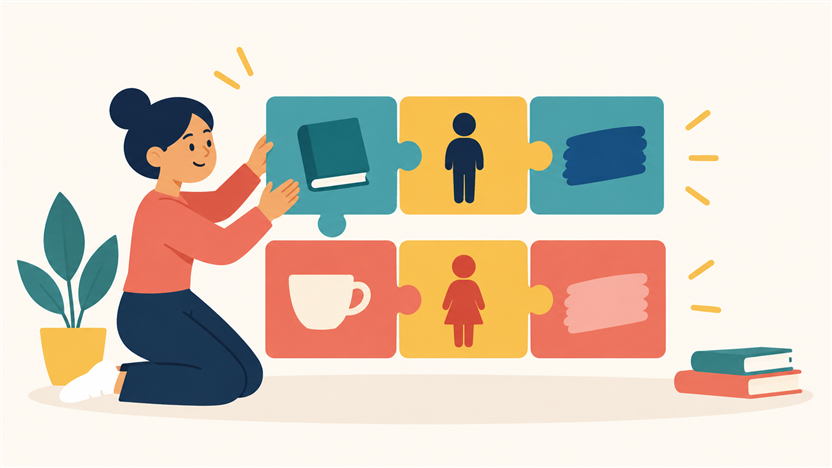
Practice in four-part sets:
- el coche rojo
- los coches rojos
- la bicicleta roja
- las bicicletas rojas
This makes gender and number visible as a coordinated pattern.
Know which adjectives change
Adjectives ending in -o usually change for gender and number:
alto, alta, altos, altas
Many adjectives ending in -e or a consonant do not change for gender, but they still change for number:
un libro interesante, una película interesante, unos libros interesantes, unas películas interesantes
Nationality adjectives often change: español, española; inglés, inglesa. Learn them through examples rather than trying to infer every pattern during speech.
Understand nouns for people
Some nouns change form according to the person: el profesor, la profesora. Others keep the same noun and change only the article: el estudiante, la estudiante; el artista, la artista.
Usage involving people, identity, and inclusive language varies across communities and contexts. Follow the language people use for themselves. The core learning point remains the same: notice the complete noun phrase rather than memorizing a bare ending.
Watch the stressed-a pattern
Some feminine nouns beginning with a stressed a- or ha- use el in the singular for sound reasons:
- el agua fría
- el águila blanca
- el hacha nueva
They remain feminine. The adjective is feminine, and the plural returns to las: las aguas frías.
Learn one complete example instead of thinking “el means masculine.” Articles usually reveal gender, but this pattern reminds you to pay attention to the whole phrase.
Practice agreement as a listening skill
Gender is not only something you produce. Articles and adjective endings help listeners predict and track nouns.
When listening, choose one short passage and focus on noun phrases. Write what you hear: una decisión importante, los últimos años, esta nueva oportunidad. Replay with a transcript and mark every agreement signal.
This trains your ear to notice the system native speakers rely on. What you consistently hear becomes easier to produce.
Correct the phrase, not one letter
If you say el casa blanco, do not correct only el or only the adjective. Repeat the complete phrase: la casa blanca. Then place it in a sentence: La casa blanca está al final de la calle.
The error is a broken relationship among words. Repairing the entire unit strengthens the right relationship.
Keep an “agreement hit list” of five recurring errors. Review those phrases for a week, then replace them. A small rotating list works better than a permanent record of every mistake.
Use retrieval games
Place ten objects or pictures in front of you. Name each with an article and adjective. Then make them plural. Next, add a demonstrative:
la taza azul → las tazas azules → estas tazas azules
Try a rapid sorting game: say el or la before revealing the answer. For missed nouns, create a memorable mini-sentence. La mano tiene cinco dedos is easier to remember than “mano is an exception.”
Prioritize high-frequency nouns
You will not eliminate every gender error immediately. Focus first on words you use constantly: el problema, la gente, el tiempo, la vez, el trabajo, la parte, el día, la noche.
Correct agreement around frequent nouns improves your speech more than mastering the gender of rare objects. Frequency builds automaticity because you receive more opportunities to notice and use the pattern.
A seven-day agreement challenge
Day 1: Select twenty frequent nouns and add articles.
Day 2: Add one useful adjective to each noun.
Day 3: Convert ten phrases from singular to plural.
Day 4: Find noun phrases in one short audio transcript.
Day 5: Describe a room using articles, colors, and locations.
Day 6: Record a two-minute description of a person or place. Review only agreement.
Day 7: Repeat the recording without notes and compare.
Aim for automatic agreement, not perfect guessing
Even native speakers occasionally hesitate over an unfamiliar noun. Your job is to build strong expectations, memorize common exceptions, and respond well when you discover a mistake.
Learn la mesa, not mesa. Learn el problema difícil, not two disconnected facts. Listen for agreement, practice complete phrases, and correct the whole unit. Over time, the matching endings stop feeling like extra calculations. They begin to sound right—and that sound is one of the foundations of fluent Spanish.