Your mind was full of Spanish five minutes ago. Now someone is looking at you, waiting for an answer, and every useful word has vanished.
Freezing in conversation is not proof that you “do not know Spanish.” Recognition and real-time production are different skills. A word you understand in a book may not be ready for instant retrieval under social pressure. Add fear of making mistakes, and the brain may become even less cooperative.
The goal is not to eliminate nervousness before speaking. The goal is to build a conversation system that still works while you are nervous.
Give yourself permission to speak smaller Spanish
Many learners freeze because the sentence they want is too ambitious. They try to reproduce the exact thought they would express in English, with the same nuance, humor, and detail.
Reduce the message.
Instead of “I was supposed to meet my friend, but she canceled at the last minute, so I ended up staying home,” begin with:
Iba a ver a una amiga. Canceló el plan. Entonces me quedé en casa.
Three simple sentences move the conversation forward. Complexity can grow later. Communication is not a writing contest conducted at speaking speed.
Memorize rescue phrases
Fluent speakers know how to manage a conversation when language fails. Build a small emergency kit:
- Dame un segundo. — Give me a second.
- Estoy pensando cómo decirlo. — I’m thinking about how to say it.
- No recuerdo la palabra, pero es… — I don’t remember the word, but it is…
- Es una cosa que se usa para… — It’s a thing used for…
- ¿Cómo se dice…? — How do you say…?
- Quise decir… — I meant…
- ¿Me expliqué bien? — Did I explain myself clearly?
Practice these aloud before you need them. A rescue phrase creates time, lowers pressure, and keeps you in Spanish.
Prepare islands of confidence
An “island” is a topic you can discuss comfortably for one or two minutes. Useful islands include your work, family, city, hobbies, weekend, reasons for learning Spanish, and recent travel.
For each topic, prepare:
- Five essential words
- Three useful verbs
- Two opinions
- One short story
- Two questions you can ask the other person
For travel, your words might include vuelo, maleta, hotel, retraso, and reserva. Your verbs might be viajar, llegar, and perder. Your story might describe a missed train.
Do not memorize a rigid paragraph. Practice combining the pieces in different ways. You are building a reliable neighborhood, not a single road.
Replace performance with curiosity
Freezing gets worse when your attention turns inward: “Was that article correct? Do I sound ridiculous? What if I use the wrong tense?” Shift attention toward the other person.
Listen for something you genuinely want to know. Ask follow-up questions:
- ¿Y cómo fue?
- ¿Desde cuándo?
- ¿Por qué decidiste hacer eso?
- ¿Te gustó?
- ¿Qué pasó después?
Conversation is shared work. You do not need to deliver a monologue. A good question reduces your speaking load and gives you useful language to reuse in your response.
Train retrieval, not just recognition
Rereading notes feels comfortable because the answer is visible. Conversation requires recall with no answer in front of you.
Close the book and speak. Look at a picture and describe it. Read a question, hide it, and answer. After watching a short video, retell it without the transcript. Use a timer so you practice producing language before it feels polished.
A simple drill is “three, two, one.” Speak about one topic for three minutes. Repeat the same message in two minutes. Repeat it again in one minute. Each round becomes smoother because the content is familiar, while the time limit encourages quicker retrieval.
Rehearse predictable conversations
Many real interactions follow patterns: ordering food, introducing yourself, checking into a hotel, describing a problem, or making weekend plans.
Write the likely questions, then practice your answers aloud. Add one surprise question so the practice does not become mechanical.
For a restaurant:
- ¿Qué va a tomar?
- ¿Está listo para ordenar?
- ¿Quiere algo más?
- Surprise: Hoy no tenemos ese plato. ¿Prefiere…?
Role-play both sides. When the real conversation arrives, you will recognize its structure and have more mental space for unexpected details.
Use a conversation ladder
Do not jump from silent study to a crowded dinner with six fast speakers. Increase difficulty step by step:
- Record a private voice note.
- Speak to an AI or structured practice tool.
- Exchange audio messages with a partner.
- Have a scheduled ten-minute call.
- Speak one-to-one for thirty minutes.
- Join a small group.
- Enter an unstructured native conversation.
Stay on each step long enough to gain control, but not so long that comfort becomes avoidance.
Decide how you want corrections
Constant interruption can make anxious speakers shut down. No correction can allow repeated errors to settle. Ask a tutor or exchange partner to use a clear system.
During a fluency activity, they can note errors and discuss the three most useful ones afterward. During a focused grammar activity, immediate correction may be appropriate. You can also ask for recasts: if you say La problema es grande, your partner naturally responds, Sí, el problema es grande.
Choose one correction target per conversation. Perhaps today you monitor past tense; tomorrow you focus on noun gender. Trying to control everything at once makes spontaneous speaking nearly impossible.
Recover after a mistake
A mistake becomes damaging only when it ends the interaction or convinces you not to try again. Learn a three-step recovery:
- Correct it quickly if the correction is obvious: Ayer voy… perdón, ayer fui.
- Continue the message.
- Note the error afterward if it is worth studying.
Do not hold a courtroom trial in the middle of your sentence. Native speakers self-correct, restart, and search for words too.
Build automatic openings
The first thirty seconds often carry the most anxiety. Prepare two or three openings:
Hola, soy Paul. Vivo en… y llevo… estudiando español. ¿Y tú?
Esta semana ha sido bastante ocupada porque… ¿Cómo ha ido la tuya?
An automatic opening gives your nervous system time to settle. Once the exchange begins, curiosity can take over.
A weekly speaking plan
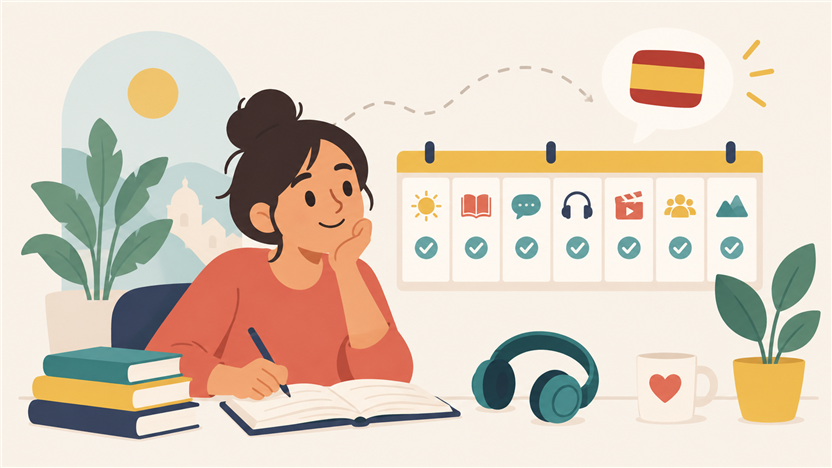
Monday: Record a two-minute voice note about your day.
Tuesday: Practice one conversational island with the three-two-one drill.
Wednesday: Shadow a short dialogue and copy its rhythm.
Thursday: Exchange three audio messages with a partner.
Friday: Hold a ten-minute conversation with one correction target.
Saturday: Review the phrases you needed but could not retrieve.
Sunday: Record the same topic as Monday and notice what became easier.
This plan is short enough to repeat. Frequency matters more than one exhausting weekly session.
Measure courage and recovery
If you measure only grammatical accuracy, conversation may always feel disappointing. Track behaviors you can control:
- Did you begin speaking without a long delay?
- Did you use a rescue phrase instead of switching to English?
- Did you ask follow-up questions?
- Did you continue after a mistake?
- Did you communicate the main idea?
Confidence usually arrives after repeated action, not before it. Each manageable conversation teaches your brain that speaking Spanish is survivable, useful, and sometimes genuinely fun.
You do not need to become fearless. You need simple language, reliable phrases, practiced topics, and a method for recovering when your mind goes blank. That is how the freeze loses its power—and how Spanish becomes something you use, not merely something you study.