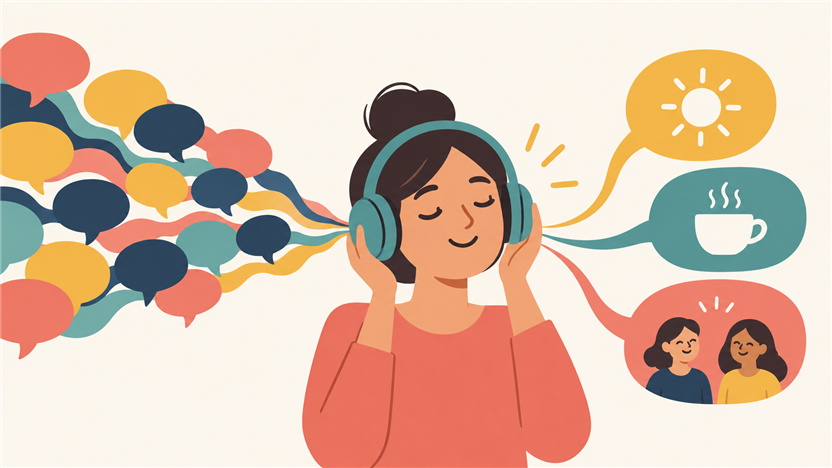
You can understand your teacher. You can follow a learning app. Then a native speaker says one ordinary sentence and it sounds like a single, extremely long word.
This is one of the most frustrating stages of learning Spanish. It is also normal. Research on second-language Spanish listening shows that sentence length, speech rate, and the listener’s proficiency interact. In everyday terms: speed matters, but speed is rarely the only problem. Vocabulary, sound recognition, grammar, attention, and familiarity with an accent all influence what you hear.
The answer is not simply to play difficult audio for hours and hope your ears surrender. You need listening practice that is challenging enough to produce growth and clear enough to teach your brain what it missed.
Spanish is not one uninterrupted blur
Written language gives you spaces. Speech does not. Native listeners identify word boundaries automatically because they already know which sound combinations and phrases are likely.
Consider ¿Qué vas a hacer? In careful speech you may expect four separate units. In conversation, the vowels connect and the phrase may feel compressed. Para may sound closer to pa’ in casual speech. Final consonants may weaken in some regions. Familiar phrases shrink because speakers expect listeners to recognize them.
Your first task is therefore not “hear faster.” It is “recognize familiar language in its spoken shape.”
Separate knowledge problems from sound problems
Take a short clip you did not understand and read the transcript.
- If the transcript is still difficult, you have a vocabulary or grammar problem.
- If the transcript is easy, but the audio is difficult, you have a sound-decoding problem.
- If you understand each sentence but lose the overall point, you may have an attention or working-memory problem.
Each problem needs different practice. Reading more will not automatically fix sound decoding. Replaying one incomprehensible clip will not supply missing vocabulary.
Use the three-pass listening method
Choose audio between 30 seconds and two minutes. It should be interesting and mostly understandable.
Pass 1: Listen for the situation. Who is speaking? Where are they? What is the main topic? Do not pause.
Pass 2: Listen for anchors. Write key nouns, verbs, numbers, names, and connecting words. Do not attempt a full transcription.
Pass 3: Check and repair. Read the transcript or subtitles. Mark the exact places where your ears lost the message. Listen again while reading, then once more without the text.
This sequence teaches listening. Watching everything with English subtitles mainly teaches reading English while Spanish plays nearby.
Work with narrow listening
Jumping from a Colombian news report to a Spanish comedy and then to a Puerto Rican interview creates constant novelty. Variety is valuable later. At first, narrow listening produces faster results.
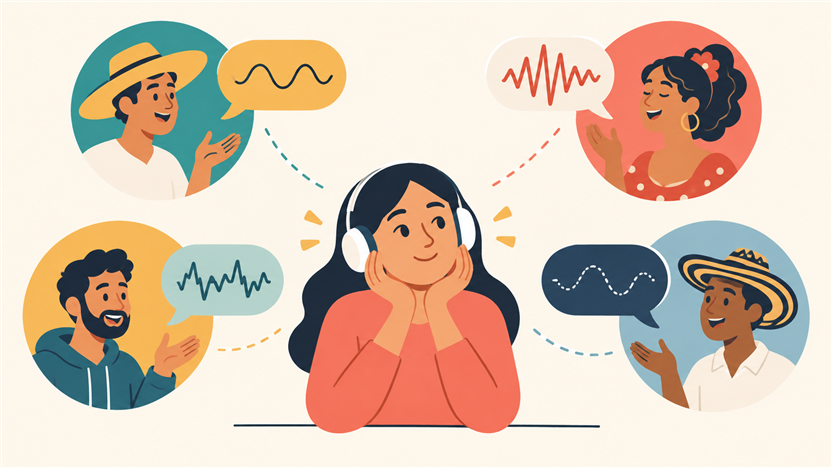
For one or two weeks, follow the same speaker, podcast, series, or topic. The vocabulary repeats. The voice becomes familiar. You learn the speaker’s rhythm and favorite expressions. Your comprehension rises, which gives your brain more capacity to notice grammar and pronunciation.
After building confidence with one variety, add another. The goal is not to choose the “correct” accent. It is to create a stable base and then expand.
Train phrases, not isolated sounds
When a phrase repeatedly defeats you, save the full phrase:
- lo que pasa es que…
- a ver si…
- es que no sé…
- me acabo de dar cuenta…
- ¿sabes lo que te digo?
Listen, read, and repeat it. Then find or create two more examples. High-frequency phrases act like landmarks. Once you recognize them instantly, the words around them become easier to locate.
Practice micro-dictation
Dictation is powerful when it is short. Select five to ten seconds of audio. Play it several times and write exactly what you hear. Compare your version with the transcript.
Do not merely correct the words. Diagnose the miss:
- Did two vowels connect?
- Was a consonant weakened?
- Did you expect a different verb tense?
- Was the expression unfamiliar?
- Did you know the written word but not its pronunciation?
Replay the sentence, read it aloud, and shadow it. One carefully studied sentence can teach more than twenty minutes of passive exposure.
Increase speed gradually
Slowing audio can help you inspect a difficult passage, but living permanently at 0.75 speed can make normal speech feel shocking. Use a speed ladder.
Start at the slowest speed that preserves natural rhythm—perhaps 0.85 or 0.9. Once you understand the clip, return to normal speed. For very familiar material, try 1.1 speed and then normal speed again. Normal may suddenly feel spacious.
The key is comprehension before speed. Practicing noise at 1.5 speed does not create advanced listening. It creates faster noise.
Learn the connectors that reveal structure
Listeners do not process every word equally. Connectors tell you how ideas relate:
- pero signals contrast.
- porque gives a reason.
- aunque introduces a concession.
- entonces moves the story forward.
- o sea reformulates an idea.
- por eso presents a result.
- al final often introduces an outcome.
Make these words automatic. They help you predict what comes next and recover even when you miss details.
Stop trying to catch every word
Native listeners also miss words. They use context, expectations, and later information to fill gaps. Learners often freeze after one unknown expression and miss the next three sentences.
Practice letting a gap remain open. Ask: “What do I still know?” Perhaps you missed the name of a dish, but you know the speaker disliked it because it was too salty. That is successful comprehension.
During live conversation, use clarification strategically:
- ¿Puedes repetir la última parte?
- ¿Dijiste que llegaste ayer?
- Entendí lo de la reunión, pero no la hora.
Specific questions are easier to answer than a general No entiendo.
Make pronunciation part of listening
Your listening improves when your mouth understands the movements that produce Spanish. Read a transcript aloud. Copy vowel length, stress, and linking. Record yourself, then compare.
You do not need a perfect accent. Production practice makes sound patterns more noticeable. If you have never tried to pronounce the tap in pero or connect the vowels in voy a, those patterns may remain harder to recognize.
A 20-minute daily listening workout
Minutes 1–3: Listen once without text and summarize the topic.
Minutes 4–8: Listen again and collect key words and connectors.
Minutes 9–13: Check the transcript and investigate two difficult sentences.
Minutes 14–17: Shadow those sentences and the surrounding passage.
Minutes 18–20: Listen once more without text and give a spoken summary in Spanish.
Use the same clip again the next day before starting a new one. Spaced repetition helps spoken forms stick.
How to measure improvement
Do not judge listening only by whether native media feels easy. Track smaller changes:
- How much can you summarize after one listen?
- How often do you need the transcript?
- Can you identify why you missed a sentence?
- Can you follow a familiar speaker for longer?
- Do you recover quickly after an unknown word?
Fast Spanish becomes understandable through hundreds of successful acts of recognition. Choose comprehensible material, listen in short loops, study the gap between audio and transcript, and gradually widen your range of speakers. What sounds like a blur today will eventually separate into phrases—and then into meaning.