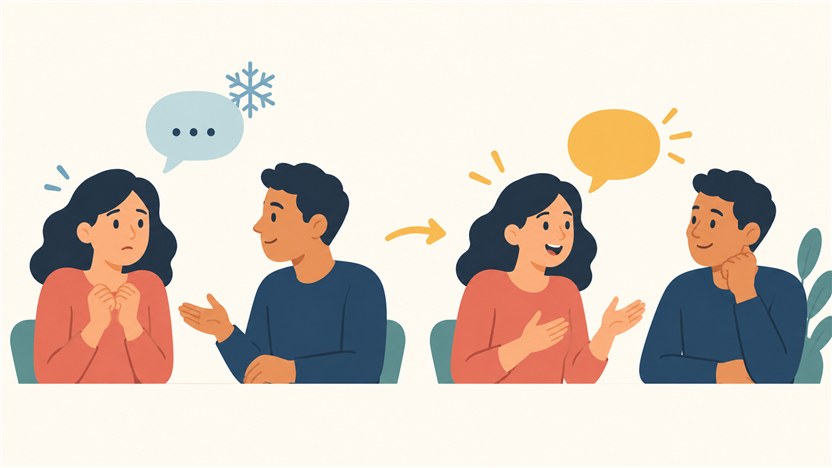
You know the feeling. Someone asks you a simple question in Spanish. You understand it. You even know the words you need. Yet your brain opens an invisible English document, writes the answer, translates every line, checks the grammar, and finally sends the sentence to your mouth. By then, the conversation has moved on.
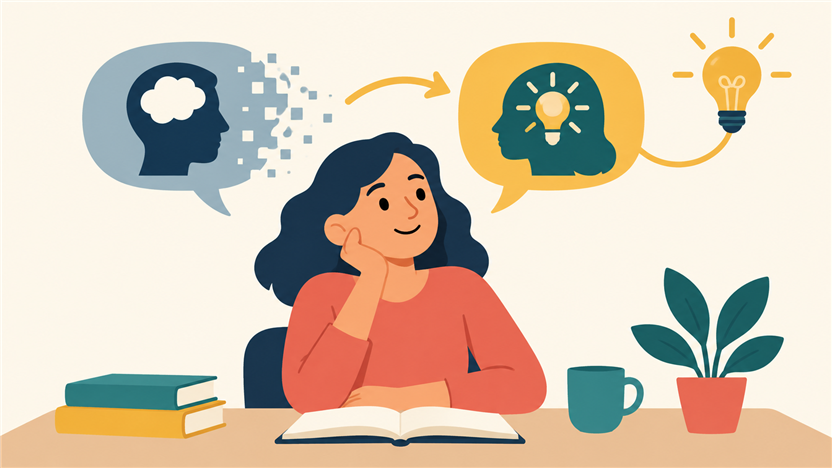
This does not mean you are bad at Spanish. It means you have trained translation more than communication. Translation can help you understand new material, but fluent conversation requires a faster route: meaning directly to Spanish.
The good news is that you can build that route deliberately. You do not need to “think in Spanish” all day or wait until you become advanced. You can start with tiny, practical habits today.
Why word-for-word translation slows you down
English and Spanish do not organize every idea in the same way. English speakers say “I am cold,” while Spanish speakers usually say Tengo frío—literally, “I have cold.” English asks, “How old are you?” Spanish asks ¿Cuántos años tienes?—“How many years do you have?”
If you translate individual words, natural Spanish can look illogical. If you learn complete ideas, it becomes predictable.
Word-for-word translation also creates three problems:
- It overloads working memory. You are choosing vocabulary, changing word order, conjugating verbs, and monitoring pronunciation at the same time.
- It imports English patterns. You may produce sentences that are technically understandable but unnatural.
- It makes you afraid of mistakes. Every sentence begins to feel like a test that must be perfect before you say it.
The solution is not to ban English. The solution is to make Spanish chunks easier to retrieve than translated sentences.
Learn phrases as single units
Native speakers do not construct every sentence from grammar rules. They rely heavily on familiar groups of words: no sé, me parece que, tengo que, por eso, depende de, ¿qué quieres decir?
Learn these as complete units. Do not store depende in one mental drawer and de in another. Store depende de as one tool meaning “it depends on.”
Start a small phrase bank organized by purpose:
- Giving an opinion: Creo que…, Me parece que…, Para mí…
- Buying time: A ver…, Déjame pensar…, Pues…
- Clarifying: ¿Qué significa…?, ¿Puedes repetirlo?, ¿Quieres decir que…?
- Connecting ideas: pero, porque, así que, aunque, por ejemplo
- Repairing mistakes: Perdón, quise decir…, No sé cómo se dice, pero…
Ten useful chunks will improve your conversation more than fifty isolated nouns.
Describe what you see in simple Spanish
Your brain needs practice connecting meaning directly to Spanish. A quick way to create that connection is to narrate ordinary moments.
While making coffee, say:
Necesito una taza. El café está caliente. Voy a poner un poco de leche. Ahora voy a trabajar.
While walking:
Hay mucha gente. Un hombre está hablando por teléfono. Hace calor. El autobús viene ahora.
Keep the language easy. This is not the moment to prove how much grammar you know. Your goal is speed and automatic recall. If you do not know a word, go around it. A kettle can become la cosa para calentar agua. That skill—explaining around a missing word—is part of real fluency.
Use pictures instead of English prompts
Traditional flashcards often show “chair” on one side and silla on the other. That strengthens an English-to-Spanish route. Whenever possible, use a picture, a situation, or a Spanish definition instead.
For silla, use a photo. For agotado, imagine how you feel after a long trip. For darse cuenta de, save a short example: Me di cuenta de que no tenía las llaves.
When reviewing, do not merely name the item. Make one short sentence. The extra context helps the word become usable rather than merely recognizable.
Practice answer patterns
Conversation becomes faster when common questions have familiar answer shapes. Choose five questions you often hear:
- ¿De dónde eres?
- ¿A qué te dedicas?
- ¿Qué hiciste el fin de semana?
- ¿Qué te gusta hacer?
- ¿Por qué estudias español?
Prepare three versions of each answer: ten seconds, thirty seconds, and one minute. Do not memorize a speech word for word. Memorize the route through the answer.
For example:
Estudio español porque viajo mucho a México. Al principio quería aprender frases básicas, pero ahora también quiero conversar con mis amigos y entender mejor la cultura.
Repeat the answer on different days, changing a detail each time. Repetition creates automaticity; variation keeps it flexible.
Delay the dictionary
Looking up every unknown word interrupts comprehension and reinforces translation. Try a three-step rule:
- Guess from context.
- Continue if the word is not essential.
- Look it up later if it repeats or blocks the main idea.
When you do look up a word, read Spanish examples. Notice what words appear beside it. A verb is much more useful when you learn its companions: soñar con, acordarse de, quedar con alguien.
Shadow short, understandable audio
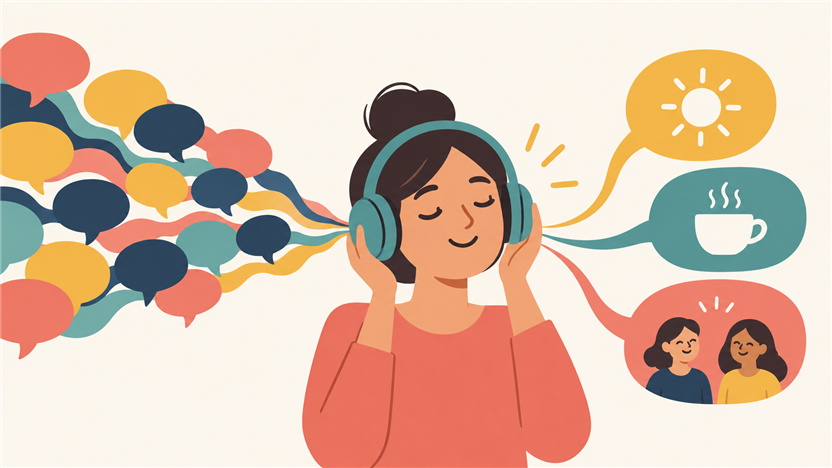
Choose a clip of 10 to 20 seconds with clear Spanish and a transcript. Listen once for meaning. Listen again while reading. Then play it sentence by sentence and speak along with the recording.
This is called shadowing. It trains your mouth to reproduce complete Spanish patterns without rebuilding them through English. Copy the rhythm, pauses, and melody—not just the consonants.
Use material you mostly understand. If every line contains unknown vocabulary, the exercise becomes decoding rather than automatic speaking.
Create Spanish-only moments
An entire Spanish-only day is unrealistic for many learners. A five-minute Spanish-only zone is manageable.
During those five minutes:
- Describe your surroundings.
- Answer a familiar question.
- Retell a short video.
- Plan tomorrow aloud.
- Send yourself a voice note.
If English appears in your mind, do not panic. Return to the simplest Spanish you can produce. “I need to reschedule my appointment” can temporarily become Necesito cambiar la hora. Simple and immediate beats sophisticated and silent.
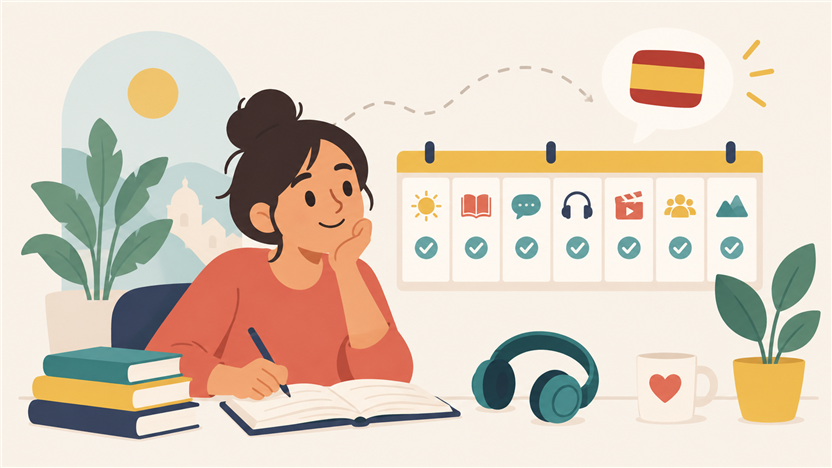
A seven-day anti-translation routine
Day 1: Choose 15 conversational chunks and record yourself saying them.
Day 2: Describe one room for five minutes without using a dictionary.
Day 3: Prepare short answers to five common questions.
Day 4: Shadow a 15-second audio clip five times.
Day 5: Retell a simple story using primero, después, pero, and al final.
Day 6: Have a ten-minute conversation. Use a repair phrase whenever you get stuck.
Day 7: Record a one-minute reflection about your week. Compare it with Day 1, not with a native speaker.
What progress actually feels like
You probably will not wake up one morning thinking only in Spanish. The change is quieter. First, a few expressions arrive without translation. Then familiar questions produce immediate answers. Later, you notice that you understood a joke before you had time to convert it into English.
Do not measure success by whether English ever enters your mind. Measure how quickly you return to Spanish and how well you keep communicating when a word is missing.
Fluency is not the ability to create a perfect sentence in private. It is the ability to keep meaning moving between people. Build that ability with chunks, pictures, repeated answer patterns, short narration, and regular conversation. The direct route from meaning to Spanish will become stronger every time you use it.